
A surge protector costs a small fraction of the compressor it protects. That is the whole argument.
Serving Phoenix, AZ
# ROC 102297
Rated by BBB
An HVAC surge protector is a device wired at the outdoor unit or the electrical panel that diverts voltage spikes away from your air conditioner’s electronics.
It is one of the least expensive things you can add to a cooling system and it guards the most expensive parts of it. That is the reason these exist. Below is what they do, whether you need one, and what they do not cover.
You need one if your air conditioner has any electronic control board, which covers essentially every system built in the last fifteen years, and especially variable-speed and communicating systems. Older single-stage systems with simple mechanical controls are less vulnerable, though the compressor and motors still are not immune.
Three reasons this matters more in Phoenix than in a lot of the country.
Monsoon season lightning. Summer storms here produce a lot of lightning, and a nearby strike does not need to hit your house to send a surge down the utility line into it.
Utility switching and grid load. Extreme summer demand means more switching events on the grid, and each one can produce a voltage transient.
Your AC runs constantly for five months. A device that is energized and operating is exposed. Phoenix systems spend far more hours energized than systems in mild climates, so the odds of being running when a surge arrives are simply higher.
The systems most worth protecting: anything variable speed or communicating, anything with a manufacturer warranty you want to keep intact, and any system you just paid to install.
| Type | Where it goes | What it protects |
|---|---|---|
| HVAC surge protector | At the outdoor unit’s disconnect | The air conditioner or heat pump only |
| Whole-home surge protector | At the main electrical panel | Every circuit in the house, including HVAC |
| Both together | Panel and unit | Layered protection |
Installation is quick either way. If a tech is already at the house for a repair, a tune-up or an installation, adding a surge protector usually adds [under an hour] and no separate trip.
At the outdoor unit’s disconnect box, in most cases. That is the last electrical point before power reaches the condenser, so a device there catches surges arriving on that circuit regardless of whether they came from the utility or from inside the house.
Whole-home protectors install at the main electrical panel instead and protect every circuit in the house, HVAC included. The two are not the same job and they are not interchangeable.
Both, if you can. Here is the difference.
Whole-home protection at the panel stops the large external surges, mostly from lightning and utility events, before they get into the house wiring. It covers everything: HVAC, appliances, electronics.
A unit-level device at the AC handles what the panel device lets through, plus surges generated inside the house. Motors starting and stopping create their own transients, and your own air conditioner’s compressor is one of the biggest motor loads in the building.
Layered protection is the standard recommendation in the electrical trade for this reason. If the budget only allows one, the panel-level device covers more of the house, and the unit-level device better protects the single most expensive piece of equipment you own.
Worth stating plainly, because this is oversold in some corners of the industry.
Lightning damages home equipment far more often through the wiring than through a direct hit on the building. That distinction is the part most homeowners have backwards, and it decides what protection is worth fitting.
Four routes, and they need different responses.
Down the utility line. The most common by far. A strike on a distribution line or transformer sends a large transient along the incoming service into your panel and out to every circuit. This is what panel-level protection is for.
Through the ground. A nearby ground strike raises the local ground potential, and that difference can push current through your grounding system into equipment. Good grounding and bonding matters here.
Induced into house wiring. A strike close by can induce a spike in nearby wiring without touching it. Usually smaller than a conducted surge, and usually handled by layered protection.
A direct strike on the structure. Rare, and beyond what surge protection addresses. That needs a lightning protection system, meaning air terminals, down conductors and grounding electrodes, which is specialist structural work and a different trade.
If the same component keeps failing, the component is not the problem. This is the visit that finds what is destroying it.
A capacitor that fails once is a capacitor at the end of its life. A capacitor that fails three summers running is a symptom. Voltage outside the equipment’s range, a loose or corroded connection generating heat, an undersized circuit, or a grounding problem will all quietly destroy electrical components on a schedule, and none of them shows up unless somebody measures.
Heat raises resistance, so connections in an outdoor disconnect or a [150] degree attic spend five months in conditions that accelerate corrosion and insulation breakdown. Run hours mean start cycles, and every compressor start draws several times its running current, which is when marginal connections and tired capacitors actually fail. And summer grid stress means more switching events on the utility side, each one a chance for a transient to reach your equipment.
You get a written report with the readings, what is outside spec, and what that is likely doing to your equipment. If the finding is that the supply is healthy and your capacitor failures were bad luck, that is a legitimate result and you will get it.
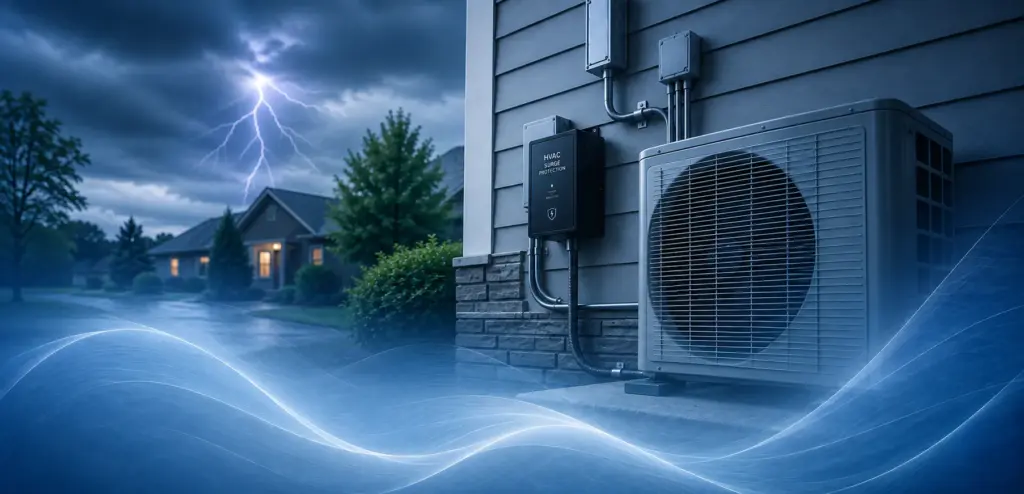
Panel-level protection for every circuit in the house, including the HVAC system.
Call (602) 437-0066 or use the form. If we are already scheduled to be at your house, mention it and we can usually handle it on the same visit.
If your system has an electronic control board, which nearly all systems from the last fifteen years do, then yes, it is worth having. Control boards and variable-speed motor drives are the components a surge takes out, and they are expensive to replace. The device costs a small fraction of what it protects.
Under an hour for a unit-level device in most cases. It is fast enough that if a tech is already at your house for a repair, a tune-up or an installation, it can be handled on that visit with no separate trip.
At the outdoor unit’s electrical disconnect, which is the last point before power reaches the condenser. Whole-home devices go at the main panel instead.
Sometimes, often with a deductible that approaches or exceeds the cost of the repair, and coverage varies a great deal between policies. Check yours rather than assuming. The relevant point is that a surge protector costs less than most deductibles.
No, and that is the important point. Most lightning-related equipment damage comes from a strike some distance away, on a utility line, a transformer or the ground, that sends a surge along the incoming power into your house. The house is untouched and the control board is destroyed.
Usually one of four things. Heat, since capacitors are temperature rated and Phoenix installations often run past that rating. Voltage outside the equipment’s range. Excessive start cycles from a control or sizing problem. Or a replacement capacitor that was the wrong rating for the unit. All four are identifiable with measurements, and none is fixed by fitting another capacitor.
It can be either, which is why it needs testing rather than guessing. A failing compressor draws too much current and trips a perfectly good breaker. A degraded breaker trips on a healthy load. An undersized circuit trips on a load it should never have been asked to carry. The amp draw reading tells you which.
Surge protection is electrical, it installs at the panel and the equipment, and it handles transients arriving through the wiring. A lightning protection system is structural, it is air terminals and down conductors on the building, and it handles a direct strike by giving it a controlled path to ground. Different trades, very different scale. Most homes want the first.
[Five to ten] years under normal conditions, and less if it has absorbed a large surge. They are consumable by design. Check the indicator light annually, which is something we do as part of AC maintenance, and replace the device once it has been used up.
They do different things, so there is a case for both. The panel device catches surges coming in from outside. The unit device catches what gets past it and the transients your own motors generate inside the house. If you already have the panel-level device, adding a unit-level one is the smaller of the two expenses and it protects your most expensive appliance.
Yes, and that is the most efficient time to do it. No separate trip, and the tech already has the disconnect open.

CMI-AIR is the residential division of Consolidated Mechanical, a local, family-owned commercial air conditioning company with more than 30 years of experience.
Copyright © 2026 CMI-AIR Inc. All Rights Reserved. Designed by Verge Technologies | Marketing by Jives Media