
Not cooling? Tell us what it is doing and we will get a tech out. [Same-day appointments available.]
Service available
Serving Phoenix, AZ
Rated by BBB
and after hours availability
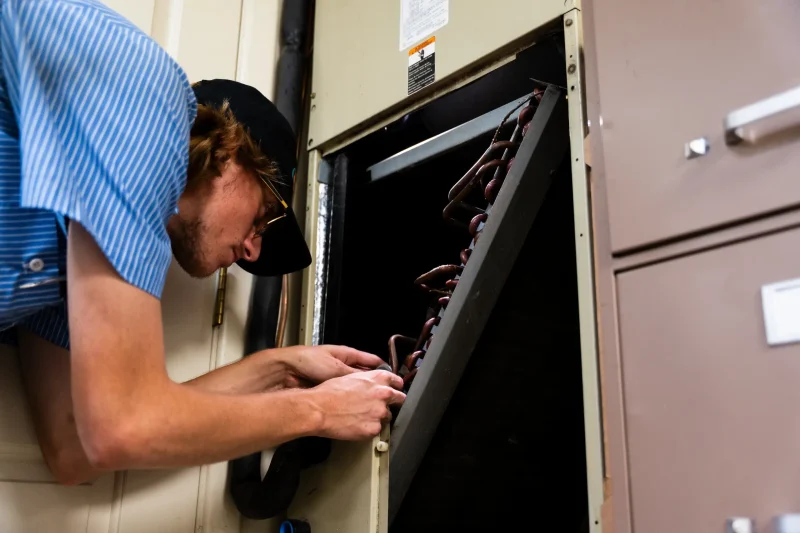
If your air conditioner has stopped cooling in Phoenix, it needs attention today, not this week. Indoor temperatures in a Valley home climb past 90 degrees within a few hours of the AC going down in summer. CMI-AIR repairs residential air conditioners across Phoenix and the surrounding cities, usually [same day].
Call (602) 437-0066 or use the form and tell us what the system is doing. That one detail is usually enough for us to know what to send.
Match what your system is doing to what it usually means. This is a starting point, not a diagnosis.
If the system is running and the air coming out is not cold, the most common causes are low refrigerant from a leak, a failed capacitor stopping the compressor from starting, a compressor that has failed outright, or a filter so loaded that airflow has collapsed. The fan running normally while nothing gets cold usually points at the compressor side rather than the blower.
Warm air from the vents comes down to four things: a clogged filter, low refrigerant, a failed capacitor, or a compressor that is not engaging. Check the filter first, because that one is free and it fixes more calls than people expect. The other three need a tech with gauges.
If the fan is running but almost nothing reaches the registers, the usual causes are a failing blower motor, a run capacitor, a badly loaded filter, or a duct problem such as a disconnected run dumping air into the attic. If nothing at all happens when the system calls for cooling, check the breaker and the float switch before anything else.
Water around the indoor unit or a stain on the ceiling almost always means the condensate drain is clogged and backing up. In Phoenix this is one of the most common calls we get, because dust and algae build up in the line. It is a straightforward fix, and it is not one to leave for a week, because the water has to go somewhere.
Ice on the coil or the refrigerant line means either airflow is restricted or refrigerant is low. Restricted airflow comes from a dirty filter, a dirty evaporator coil, or closed and blocked vents. Low refrigerant means a leak. Both drop the coil below freezing and condensation turns to ice. Turn the system off and let it thaw before the tech arrives, because a frozen system cannot be tested.
A grinding or screeching noise usually means a bearing, a motor or a compressor, and the system should be shut off rather than run through it. A buzzing or humming outside with the fan not spinning is almost always a capacitor, which is a cheap part and a very common Phoenix failure because heat kills capacitors.
A system that turns on and off every few minutes is usually dealing with a thermostat problem, a dirty coil, or equipment that is oversized for the house. A system that runs constantly and never reaches the thermostat setting is usually low on refrigerant, has a failing compressor, or is fighting leaky ductwork. Both patterns cost you money on every bill until they are fixed.
Uneven cooling between rooms is usually not the air conditioner at all. It is normally ductwork: a disconnected or crushed run, leaks in the attic, no return path in that part of the house, or a system that was never balanced. Replacing the air conditioner will not fix it. See our duct repair and sealing page.
Stop resetting it. A breaker that trips repeatedly is telling you something is drawing more current than it should, and repeated resets can damage the compressor. This one needs a tech before the system runs again.
The reason this rule is different in Phoenix than in most of the country is run hours. A ten-year-old system here has done the work of a fifteen-year-old system in a mild climate. Judge the equipment by how hard it has worked, not by the date on the label.
Two more things to weigh. If the system uses R-22 refrigerant, every future repair involving refrigerant gets more expensive, and that pushes the math toward replacement earlier. And if the failure is a compressor, the labor to get in there is most of the cost, so putting a new compressor in old equipment often means paying installation-level labor for a system you will replace anyway in three years.
We will run both numbers for you and show them side by side over five years. If repair is the right answer, we will say so, even though the replacement is the bigger ticket.
Air conditioners fail at night and on weekends, and in a Phoenix August that is not something that can wait until Monday. [CMI-AIR offers emergency AC repair in Phoenix at [hours]. [After-hours calls are/are not charged at a premium rate.]]
If the house is unsafe to be in, particularly with elderly residents, infants or pets, say that when you call. It changes how we prioritize the call.
The tech tests the system rather than guessing at it. Static pressure, refrigerant pressures, temperature split across the coil, electrical draw on the motors and compressor. Ten to thirty minutes for most calls.
Readings and the failed part, not a verdict. If a capacitor is out of spec, you see the meter. If the coil is leaking, you see where.
Where there is more than one way to solve the problem, you get all of them with the price on each. That includes the cheapest option even when it is not the one we would pick.
Most repairs are finished on the first visit. Common Phoenix failure parts ride on the truck. If a part has to be ordered, you get a date.
The tech re-tests the system, confirms it is holding temperature and pressure, and tells you what he saw that might need attention later. Anything he flags is information, not a sales pitch.
Four things worth doing, and one worth not doing.
Do not keep resetting a breaker that keeps tripping. That is the system telling you something is drawing too much current, and repeated resets can take out the compressor.
Capacitor replacement. It is the most frequent failure we see in Phoenix, because capacitors degrade with heat and this climate gives them plenty of it. Contactors and condensate drain clogs are close behind. All three are inexpensive relative to the rest of the system, which is one reason skipping maintenance is expensive: these are exactly the parts a tune-up catches.
It depends on the fault. A clogged drain or a weak capacitor, running it for a day or two is usually not going to make it worse. A grinding noise, a tripping breaker, or ice on the lines, shut it off. Running a system through a mechanical or electrical fault is how a few-hundred-dollar repair becomes a compressor replacement.
Most repairs finish in one visit, usually under two hours including diagnosis. Coil and compressor replacements are half-day jobs and sometimes need a part ordered.
[Same-day for most Phoenix calls.]
Yes. We repair all major residential brands regardless of who installed the system.
Usually yes if the leak is accessible and the system is under [12] years old. Adding refrigerant without finding the leak is not a repair, it is a delay, and it is why some homeowners end up paying for refrigerant every summer. We locate the leak before we recharge.

CMI-AIR is the residential division of Consolidated Mechanical, a local, family-owned commercial air conditioning company with more than 30 years of experience.
Copyright © 2026 CMI-AIR Inc. All Rights Reserved. Designed by Verge Technologies | Marketing by Jives Media