
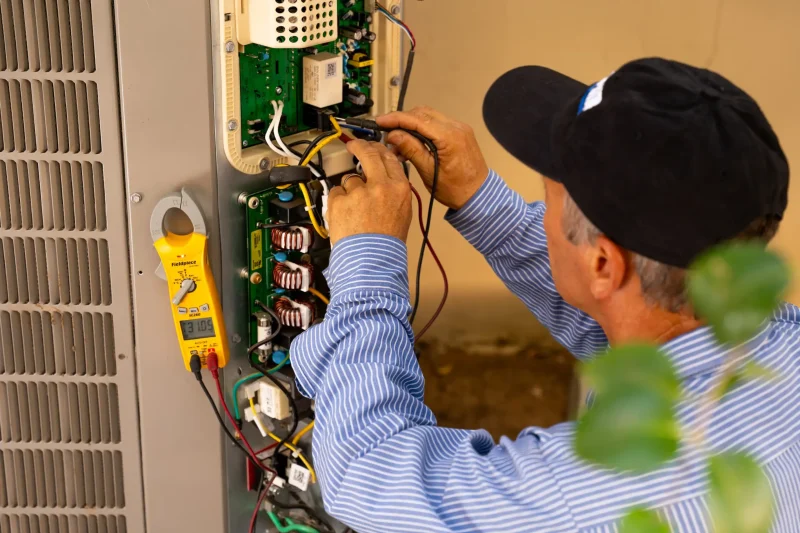
A spring tune-up catches the parts that fail in August. [42] points checked, every reading written down.
Inspection
Serving Phoenix, AZ
Rated by BBB
and after hours availability
An annual AC tune-up in Phoenix is worth it, and it is worth more here than almost anywhere else in the country. That is not a sales line, it is a function of run hours. A Phoenix system runs most of the day for five months straight, and the parts that fail are wear parts on an hours-based schedule.
CMI-AIR does AC maintenance across Phoenix and the Valley. Best time to book is [February through April], before the first heat wave fills the schedule with breakdowns.
Call (602) 437-0066 or use the form and tell us what the system is doing. That one detail is usually enough for us to know what to send.
Maintenance is preventive, but most people call because something has already started bothering them. These are the ones a tune-up usually addresses.
A bill that is rising while your habits stay the same usually means the system is working harder to do the same job. The common causes are a dust-loaded condenser coil that cannot shed heat, a clogged filter choking airflow, or refrigerant that has dropped below spec. All three are found and corrected on a maintenance visit.
A system that runs and runs without hitting the thermostat setting is usually low on refrigerant, has a dirty coil, or is losing cooled air through leaky attic ductwork. On a 110-degree Phoenix afternoon some run time is normal. Never reaching setpoint at all is not.
Turning on and off every few minutes is hard on the compressor and it means the system never runs long enough to pull humidity out. A dirty evaporator coil, a thermostat placed badly or reading wrong, or refrigerant out of spec are the usual causes, and a tune-up catches all of them.
Airflow that has gradually gotten worse usually comes from a loaded filter, a dust-coated blower wheel, or a dirty evaporator coil. A blower wheel packed with Phoenix dust can cost you a noticeable share of your airflow, and it is not something you would ever see without opening the cabinet.
A smell on startup usually points at moisture and dust sitting in the system: standing water in the drain pan, a dirty evaporator coil, or dust in the ductwork. Clearing the condensate line and cleaning the coil is part of the visit.
If you have called for repairs two or three times in the last couple of summers, the pattern matters more than any single failure. Sometimes it is one root cause nobody chased down, like a refrigerant leak that keeps getting topped off. Sometimes it is a system near the end of its life. Either way we will tell you which one it is.
Yes in Phoenix, and here is the specific reason rather than the general one.
The three most common AC failures we see in this market are capacitors, contactors and clogged condensate drains. All three are cheap parts. All three are detectable before they fail. A capacitor that has drifted out of spec reads out of spec on a meter months before it takes the compressor offline in July. A contactor with pitted contacts is visible. A condensate line that is starting to restrict shows up on a flush.
That is the whole value proposition. You are paying for someone to catch a cheap part before it becomes an emergency call at 9pm on a Saturday in August, plus a night in a 95-degree house.
Where tune-ups are oversold: they will not make an old system act new, they will not fix a sizing problem, and they will not repair leaky ductwork. If someone tells you a tune-up will cut your bill by 30 percent, be skeptical. The honest number is smaller. A dirty condenser coil and a loaded filter do cost you real efficiency, and cleaning them recovers it, but the gain is measured in single-digit percentages for most systems.
Spring, ideally February through April. The system has been idle or lightly used through winter, the schedule is open, and anything the tech finds can be fixed before it matters.
The worst time to book is late June, and it is not because the service is worse. It is because by then every HVAC company in the Valley is running emergency calls, and a maintenance appointment competes with a family sitting in a 100-degree house. You will wait longer, and if the tech finds a part that needs ordering you may be waiting through a heat wave.
Once a year is right for most Phoenix homes. Twice a year makes sense if the house is in a high-dust area, if the system is over [12] years old, or if there are pets and the filter loads fast.
Any parts or repairs the inspection turns up. Those are separate from the visit itself, they get quoted before anything is done, and you decide whether to go ahead. A tune-up that quietly turns into a repair bill is not how we work.
A plan is worth it if you would otherwise skip the tune-up. The value is in the scheduling more than anything else. [Plan members get [priority scheduling / included visits / repair discount / no diagnostic fee]], and priority scheduling matters most in the exact week when every household in the Valley is calling at once.
A plan is not worth it if you are already diligent about booking maintenance yourself and the only benefit you would use is the discount. Work out which of those you are before you sign up for anything.
Call (602) 437-0066 or use the form. [Spring appointments fill quickly, so book early if you want a specific window.]
The [42]-point inspection above, plus the condenser coil cleaning and the condensate drain flush. You get every reading in writing, along with anything that looks like it is heading toward failure and roughly how long you have. Parts and repairs are quoted separately if the inspection turns something up.
It is worth it if it is the thing that gets the tune-up on the calendar, and the priority scheduling is worth more than the discount in a market where everyone calls in the same two weeks of June. It is not worth it if you already book maintenance reliably on your own. [Confirm plan details.]
Once a year, in spring. Twice a year if the system is over [12] years old, the home is in a high-dust area, or filters load quickly. The once-a-year figure most manufacturers recommend assumes a cooling season shorter than ours.
A tune-up is scheduled, preventive, and priced flat. A service call is reactive, diagnostic, and priced by the repair. If your system is running fine, you want a tune-up. If it is not cooling, you want AC repair.
Some, not dramatically. Cleaning a dust-loaded condenser coil and replacing a clogged filter recovers efficiency the system had lost, and in a Phoenix summer that shows up on the bill. Anyone promising a large percentage cut from a tune-up alone is overselling it. The bigger efficiency wins in this market are usually duct sealing and correct system sizing.
Some of it. Change the filter on schedule, keep two feet clear around the outdoor unit, and rinse the condenser coil gently with a hose from the outside in. What you cannot do without gauges and a meter is check refrigerant charge, test the capacitor against spec, or read static pressure, and those are where the failures get caught.
Often, yes. Most manufacturers require documented annual professional maintenance to honor a parts warranty. We leave a written record of every visit for exactly that reason.

CMI-AIR is the residential division of Consolidated Mechanical, a local, family-owned commercial air conditioning company with more than 30 years of experience.
Copyright © 2026 CMI-AIR Inc. All Rights Reserved. Designed by Verge Technologies | Marketing by Jives Media